The Cape Horn Sailors
The Dutch Cape Horn Sailors – a history of courage and seamanship
The history of the Dutch Cape Horn Sailors is closely linked to the great age of Dutch sail. For centuries, Cape Horn, the notorious southern tip of South America, formed one of the toughest obstacles for ships sailing between Europe and the Pacific Ocean. Stormy winds, enormous waves, fog, cold, and ice made the passage around the Cape one of the most dangerous routes on the world’s oceans. Anyone who had rounded Cape Horn under sail could rightly call themselves an experienced seaman.
The special significance of Cape Horn for the Netherlands goes back even further. In 1616, the Dutch navigators Willem Cornelisz Schouten and Jacob Le Maire rounded the cape, which they named after their birthplace and home port of Hoorn.
In the twentieth century, as the era of the great sailing cargo ships drew to a close, a need arose to keep the memory of this special group of sailors alive. In 1957, the Association of Dutch Cape Horn Sailors was founded in Hoorn.
The association not only served a social function for former sailors, but was also involved in preserving maritime heritage and maintaining contacts with like-minded organisations at home and abroad.
An important principle was that the title Cape Horner was not simply granted to every modern offshore sailor.
According to the view at the time, one had to have actually rounded the Cape on a sailing cargo ship. This was intended to distinguish between the historical mariners who earned their living under extremely harsh conditions and modern sailors who could pass the Cape with much better navigation and weather information.
The transition from the old association in 1985 to the Dutch Cape Horn Sailors Foundation meant that this tradition could be continued even after the end of the great Dutch age of sail.
Objective of the Dutch Cape Horn Sailors Foundation
After the disappearance of the great sailing merchant navy, a need arose to preserve the memory of this extraordinary period in Dutch maritime history. The Dutch Cape Horn Sailors Foundation therefore dedicated itself to keeping the memory of the great age of sail alive, with Cape Horn as an important symbol of the craftsmanship and courage of the sailors. It did this by collecting and exhibiting historical objects and documentation, maintaining a historical room in Hoorn, issuing publications, and organising lectures and presentations on seafaring. Additionally, the foundation maintained contacts with foreign organisations involved in the history of the Cape Horn passage. In doing so, it fulfilled an important role in preserving and passing on Dutch maritime heritage.
The foundation was dissolved in 2025. The task of keeping the memory of the great age of sail alive and granting official recognition to Dutch sailors and skippers who have rounded Cape Horn under sail now lies with the Enkhuizen Nautical College.
Enkhuizer Nautical College and Cape Horn
In taking over the resources of the Dutch Cape Horn Sailors Foundation, the Enkhuizen Nautical College has set itself the following objective:
the preservation, deepening, and dissemination of knowledge about and the memory of the Dutch great age of sail and the special significance of Cape Horn within it, as part of the Dutch and international maritime heritage. The college seeks to achieve this goal through, among other things:
the preservation, deepening, and dissemination of knowledge about and the memory of the Dutch great age of sail and the special significance of Cape Horn within it, as part of the Dutch and international maritime heritage. The college seeks to achieve this goal through, among other things:
- promoting knowledge and research into the history, development, and significance of the great age of sail and the Cape Horn passage;
- sharing and making knowledge accessible through publications, lectures, exhibitions, presentations, and other forms of education and information provision;
- promoting contacts and cooperation between sailors, former sailors, maritime experts, researchers, museums, archives, associations, institutions, and other organizations involved in seafaring and maritime heritage;
- maintaining national and international contacts with organisations and individuals interested in the history and tradition of the Cape Horn passage;
- supporting and stimulating interest in sailing and maritime heritage, particularly among new generations;
- organising symposia in the Oosterkerk in Hoorn, where knowledge exchange, meeting, and bringing maritime heritage to the attention are central. The symposium provides space for lectures, discussions, presentations, and meetings between experts, researchers, sailors, enthusiasts, and other interested parties;
- maintaining an appropriate presentation of the collection in the nautical college, in order to make the history and heritage of the great age of sail and the Cape Horn passage visible and accessible to a wider audience;
- disseminating and honoring the tradition of the Cape Horners, including by recognising and recording exceptional achievements and by maintaining historical documentation and registers.
The Enkhuizen Nautical College Foundation carries out its work on a non-profit basis and may engage in all other activities that contribute directly or indirectly to achieving its objective.
To be considered for recognition, an official logbook is reviewed by a special committee, among other requirements.
An application can be sent to kaaphoorn@ezs.nl
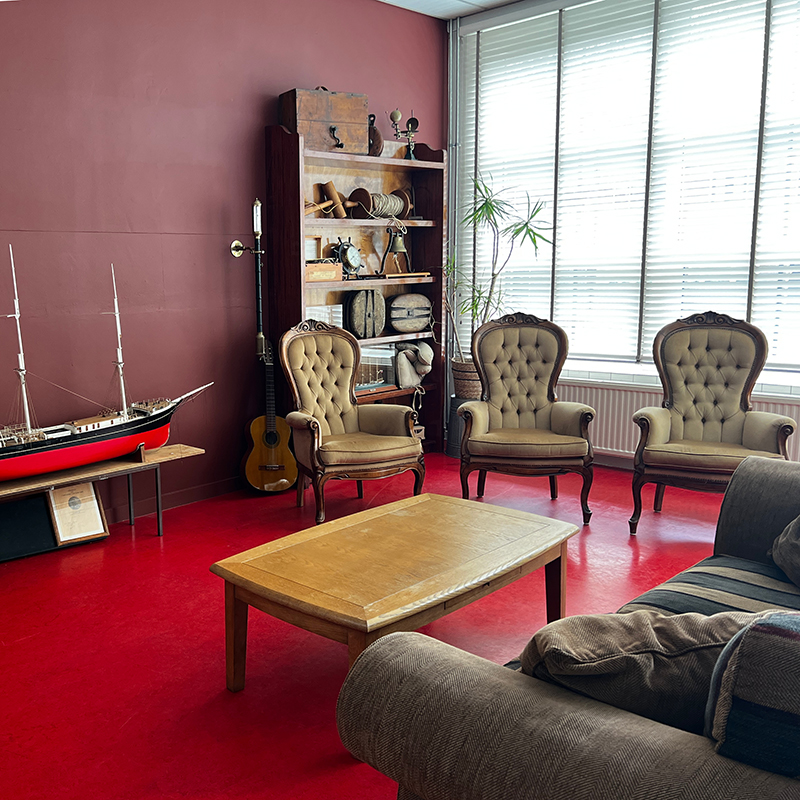
Cape Horn Lounge
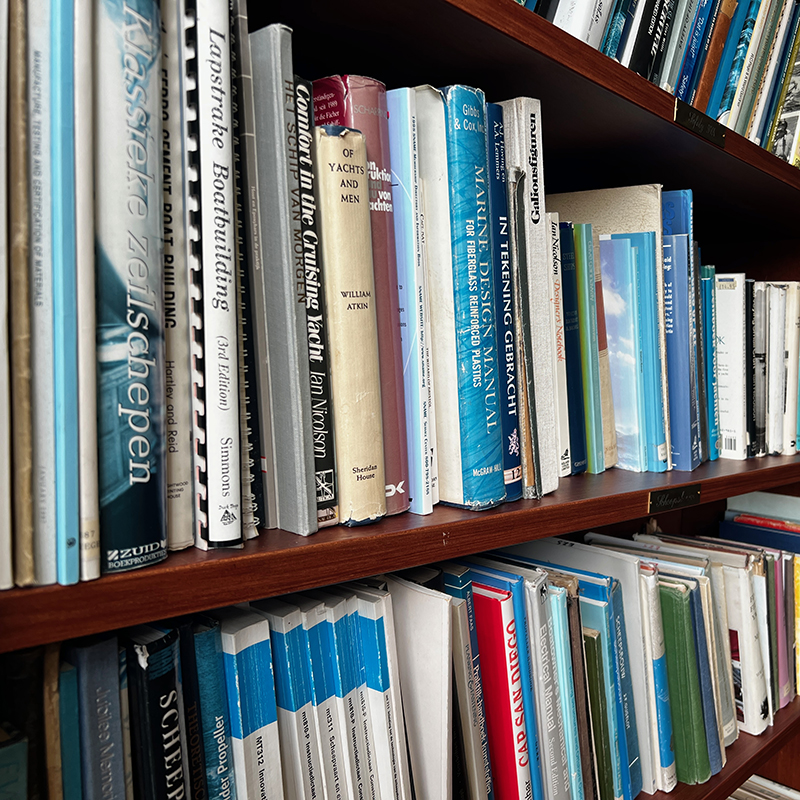
EZS Library, which also contains many books from the legacy of the Cape Horners
This post is also available in: